While researching near-future SEO and organic traffic trends for the Baltic banking sector, I came across a particularly thought-provoking paper by KPMG and the University of Melbourne: “Trust, Attitudes, and Use of Artificial Intelligence.” The study investigates how people globally - and by country - perceive and use AI tools. The findings are nuanced: although adoption of AI is growing rapidly, deep trust in these systems remains fragile.
This skepticism is understandable. Since generative AI tools like ChatGPT became widely accessible, reports of AI hallucinations (confidently wrong outputs) have rightly fueled caution. According to the Stanford AI Index (2021–2025) (interactive graph here: https://infogram.com/ai-hellucination-report-2025-1h9j6q7mz7q354g , full reports in sources 3 - 7) , hallucination rates for general use have dropped from 38% to just 8.2%, with the best models now showing less than 1%. But trust is personal - built on repeated, positive experience. And while progress is encouraging, hallucination rates can still vary wildly depending on use case and user expertise.
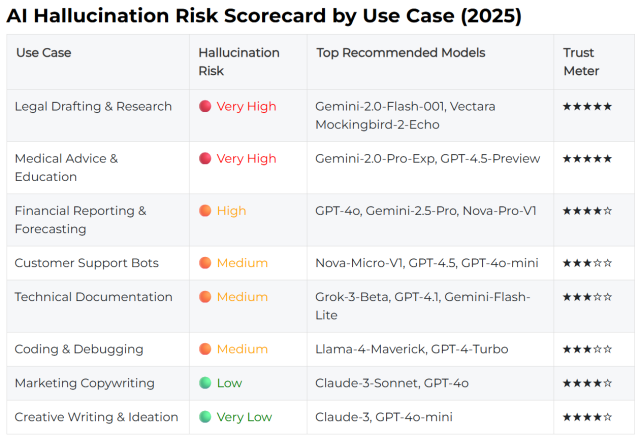 Screenshot from "AI hallucination report 2025"
Some reports that specifically look at resoning models find that hallucinations in specialized fields are persistantly high and some of the latest models due to their reasoning capabilities amplify hallucinations reaching 33% to 79% hallucination rate.
Yet even more concerning is who is using these tools most: young people aged 18–34. According to the KPMG/Melbourne research, this group shows the highest rate of AI adoption (Source 1). It’s easy to extrapolate that current teens - future university students, voters, professionals - will follow the same trend, if not amplify it. And that’s where we face a deeper issue.
The generation at risk of outsorcing their thinking
University years are a critical window for developing life-long skills like critical thinking, skepticism, and information literacy. Good academic programs are designed to stretch curiosity - requiring students to cross-check studies, cite credible sources, and reflect on opposing viewpoints.
But what happens when that process is shortcut by AI?
The study’s most alarming finding lies in a section titled “Student attitudes towards AI in education” (Source 1) that explored attitudes towards AI by students including questions regarding inapropriate and complacent use of AI. Among student AI users (nearly 58% of all surveyed):
- 50–70% showed signs of overreliance on AI
- Many replaced peer collaboration with AI collaboration
- 49% did not evaluate the information or sources given by the AI
In other words, students are not just using AI as a tool; they’re allowing it to think for them - without questioning the validity of its outputs. Given that models like ChatGPT can source content from unverified forums like Reddit, a lack of source evaluation could mean internalizing misinformation as truth.
This poses a real risk to long-term decision-making skills. If critical thinking isn’t practiced during formative years, will people be equipped to make sound decisions later - when it matters most?
The persuasiveness of AI
This concern is amplified by research into AI’s ability to persuade and shift opinions. Two studies stand out:
- “Can AI Change Your View?” (University of Zurich) explored how AI can influence users on platforms like Reddit.
- “On the Conversational Persuasiveness of Large Language Models” tested AI's ability to shift opinions in controlled trials - and found it more effective than human interlocutors, especially when responses were personalized.
At first glance, these findings may seem harmless, even fascinating. But pair them with rising trust in AI, growing usage among younger people, and a decreasing habit of critical evaluation, and the implications become deeply unsettling.
We may be approaching a future where AI tools - whether intentionally or not - become highly effective vectors for misinformation and manipulation. Not just in mass media, but in intimate, tailored interactions where the user believes they’re simply having a helpful conversation.
The Conversation We Need to Have Now This isn’t a call to abandon AI. The technology has immense potential, and in many cases, already improves lives. But we must ask difficult questions about how we’re shaping the next generation’s relationship with it.
- Are we teaching young people to evaluate AI responses, or just accept them?
- Should educational institutions rethink how they assess critical thinking in an AI age?
- How do we build digital literacy that goes beyond "how to prompt"?
These are not abstract, future-facing hypotheticals. They’re questions that affect how knowledge, belief, and agency are formed right now.
Sources used:
- kpmg
- https://www.allaboutai.com/resources/ai-statistics/ai-hallucinations/
- https://hai.stanford.edu/ai-index/2025-ai-index-report
- https://hai.stanford.edu/ai-index/2024-ai-index-report
- https://hai.stanford.edu/ai-index/2023-ai-index-report
- https://hai.stanford.edu/ai-index/2022-ai-index-report
- https://hai.stanford.edu/ai-index/2021-ai-index-report