When I first explored Amplitude, its intuitive approach contrasted with the Adobe Analytics I’ve used extensively. Curious to see how Amplitude performs in a real-world context, I partnered with Two Trouble Tails. This project offered a perfect opportunity to implement Amplitude’s free tier.

The screenshot from Amplitude analytics demo
When I first encountered Amplitude Analytics, it felt like a breath of fresh air compared to the platform I’m most familiar with—Adobe Analytics. Intrigued by its capabilities, I reached out to a community of business owners, hoping to find an opportunity to explore Amplitude in a real-world setting. Fortunately, the owner of Two Trouble Tails agreed to collaborate. (You can read about the initial phase of our collaboration in the post titled “Two Trouble Tails Meets Data Analytics.”) Here's how the experience unfolded.
About Two Trouble Tails
Two Trouble Tails is a small business founded approximately three years ago by a passionate entrepreneur during her veterinary studies. The business specialises in handcrafted enrichment toys for dogs and cats, with designs rooted in veterinary science, factoring in material safety, ergonomics, and other critical elements to ensure pet well-being.
At the time I integrated the analytics solution, the website was only a few months old. It had limited traffic, a modest product catalogue, and was built on a platform with significant restrictions on code customisation. Given these constraints, I implemented Amplitude’s free tier as a professional development exercise. Despite the challenges, I approached the project with the same level of professionalism I would apply to any high-stakes client engagement.
Understanding and Defining Data Needs
The first and most critical step in any analytics implementation is to identify and align on the data needs of the business, product, and teams involved. In the case of Two Trouble Tails, the initial setup began by introducing the Amplitude platform and guiding the process through a series of frequently asked data-related questions to help clarify analytical priorities.
When asked about specific data needs, the business owner gave a clear and focused response: "I want to know how many people are trying to purchase my products and what the traffic to the website looks like."
While this foundational insight provides a starting point, it is essential to approach implementation with future growth in mind. Therefore, a scalable and comprehensive framework was selected - Amplitude’s North Star Framework - to ensure that the analytics infrastructure can support an expanding customer base and evolving business objectives.
Further, let's look at the defined metrics according to the framework!
North Star Metric: "PurchSat" (Purchase Satisfaction)
Definition: A customer has purchased a product because they - or someone they know - had a positive experience with a previous purchase, either in terms of quality or service.
Measurement Strategy: To capture this sentiment, a new field can be added to the checkout form: “How did you hear about us?”, with response options such as:
- Saw an ad
- Friends/Family recommended
- I’ve purchased before and was satisfied
- Social media or influencer mention
- Other
This qualitative feedback, captured at the point of purchase, can be directly tracked and analysed through Amplitude to understand changes in the PurchSat metric over time; however, it cannot be directly influenced, especially the PurchSat focus answers.
Supporting KPIs
To effectively increase the North Star metric, it is essential to track additional supporting KPIs that are both actionable and influenced by business initiatives. These metrics will help build a complete picture of customer satisfaction, retention, and advocacy.
1. Net Promoter Score (NPS)
Definition: Measures how likely customers are to recommend the product to others (scale of 0–10).
Why it matters: A strong indicator of word-of-mouth potential.
Measurement: Post-purchase surveys sent via email. To increase participation, incentives such as a discount, product tips, or exclusive content can be offered.
How to influence: Focus on enhancing product quality, packaging, delivery speed, and overall customer support.
2. Repeat Purchase Rate (RPR)
Definition: The percentage of customers who make more than one purchase.
Why it matters: Directly tied to the “repeat customer” component of PurchSat.
Measurement: Use unique customer identifiers in Amplitude to track return purchases.
How to influence: Develop loyalty programs, send personalised follow-ups, and provide educational content for optimal product use, particularly for less common users, such as cat owners purchasing enrichment toys.
3. Referral Conversion Rate
Definition: The percentage of referred visitors who complete a purchase.
Why it matters: Indicates the effectiveness of organic referrals and influencer advocacy, key elements of the PurchSat metric.
Measurement: Track shared referral links using UTM parameters (e.g., utm_source=referral&utm_medium=customer) and analyse referral conversions in Amplitude.
How to influence: Simplify referral processes and provide incentives like discounts, free delivery, or non-monetary rewards such as educational content or product usage tips.
4. Customer Satisfaction Score (CSAT)
Definition: Customer satisfaction rating, typically measured on a 1–5 scale.
Why it matters: Directly reflects post-purchase sentiment and is predictive of loyalty and advocacy.
Measurement: Implement a rating and review system for registered users on product pages. This allows for both qualitative and quantitative insight into satisfaction and future purchase behaviour.
How to influence: Enhance quality assurance, provide clear usage instructions, and focus on a strong post-sale and unboxing experience.
5. High-Intent Traffic Volume
Definition: Website sessions from sources with a high likelihood of conversion (e.g., direct traffic, branded search, referrals).
Why it matters: Indicates brand recognition and word-of-mouth strength, serving as a top-of-funnel indicator for PurchSat.
Measurement: Utilise Amplitude’s built-in traffic source tracking, combined with UTM-tagged referral links, to analyse sessions and resulting conversions from these sources.
How to influence: Encourage satisfied customers to share their experiences, invest in SEO for product names, create AI-friendly content, and collaborate with influencers or pet product reviewers.
By aligning the analytics implementation with the North Star Framework, Two Trouble Tails is laying the foundation for a scalable, insight-driven growth strategy. While the current data needs are modest, the chosen structure enables future expansion and refinement.
Limitations on implementation
The next step is to assess the existing limitations in implementing the full North Star framework and explore how those constraints can be reframed as opportunities to deliver value.
Low Initial Website Traffic
As a newly established small business, Two Trouble Tails has only recently launched its webstore, and initial traffic is expected to be low. Based on Amplitude data from the period of May 16 to June 9, 2025, the website received a total of 41 unique visitors, with only one visitor converting into a customer. As of June 10, 2025, this remains the total visitor count recorded during the Amplitude implementation period.
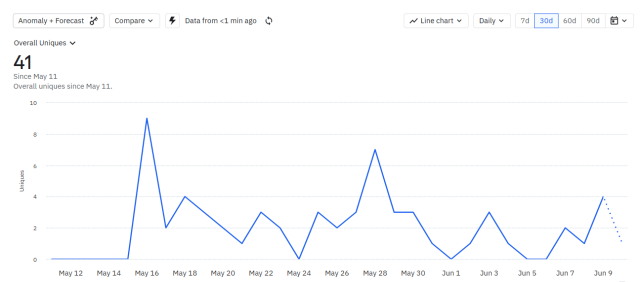
Total unique visitors for Amplitude implementation period on Two Trouble Tails website as of June 10, 2025
This low volume of traffic presents a significant limitation when attempting to define and track a North Star metric and supporting KPIs. Without a substantial increase in both traffic and conversions, meaningful metric analysis and data-driven decision-making remain challenging.
Existing Customer Habits and Sales Channels
Two Trouble Tails currently relies heavily on in-person sales at seasonal and pet-themed pop-up markets, as well as informal online transactions through social media platforms, particularly Instagram. Many returning customers continue to use these familiar channels, even though a more streamlined e-commerce experience is now available on the new website. This reliance on older purchasing habits slows the adoption of the online store and limits the effectiveness of analytics tools like Amplitude.
Limited Traffic Acquisition Strategy
At present, all website traffic is generated organically, as no paid advertising campaigns are in place. Running ads would require additional administrative overhead, particularly in terms of VAT registration and compliance, as Two Trouble Tails operates under a self-employed business status in Latvia. Advertising through international platforms like Google Ads or Meta Ads would necessitate VAT registration, which is not mandatory for the business at its current scale.
This limitation not only restricts traffic growth but also simplifies the analytics setup, as there is no need to integrate Amplitude with third-party ad platforms or manage additional tracking tags.
Data Quality Constraints
The webstore does not utilise a dedicated user identification service that assigns unique IDs beyond browser cookies. As a result, user-level tracking is less precise, with a higher likelihood of data fragmentation. This is further exacerbated by evolving cookie policies across browsers, which can degrade the accuracy and completeness of digital data over time. While the available data remains useful for basic insights and decision-making, it is important to acknowledge its limitations in terms of granularity and reliability.
Implementation of Amplitude
With all considerations in mind, the Amplitude implementation was initiated on the Two Trouble Tails website. Given the limitations in code customisation imposed by the Mozello web builder platform, a streamlined approach was chosen: deploying a tag that triggers Amplitude’s JavaScript SDK when specific events occur on the page.
The implementation began by placing the Amplitude tag in the website’s custom header code section. Additionally, a Mozello-provided cookie banner was configured to classify Amplitude as an analytics cookie, ensuring compliance with GDPR, which prohibits placing analytics cookies without explicit user consent. The website’s Privacy Policy was also updated to reflect the use of Amplitude for data collection and analysis.
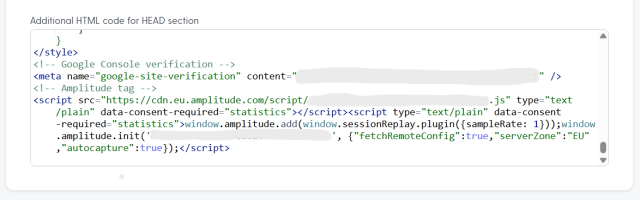
Amplitude tag in Mozello header
A notable enhancement was the use of Amplitude’s visual labelling feature - an intuitive and relatively new tool that significantly simplifies the process of identifying and tracking key user interactions. This functionality was used to tag critical touchpoints tied to the North Star metric and its supporting KPIs, helping distinguish them from other events occurring on the site.
Further configuration steps included:
- Setting up marketing channel attribution using URL parameters for paid traffic recognition
- Defining organic traffic classifications in line with both the North Star framework and standard industry practices
- Reviewing and refining the list of tracked properties and their configurations
- Validating the event taxonomy to ensure accurate data capture
- Managing Amplitude user roles and access permissions
Due to the use of Amplitude’s free tier, advanced features such as Surveys & Guides, Heatmaps, and Release tracking were not available during this phase of implementation.
As a final step, dashboards were tailored to align with our chosen North Star metric framework. Within both the Product Analytics section and the Home tab, we created a blend of current insights and placeholders for future KPIs anticipated through the framework’s evolution. Some visualisations - particularly those related to comprehensive paid and organic channel performance - are not currently feasible due to data limitations. However, we plan to expand dashboard capabilities over the next three months, as agreed with the Two Trouble Tails owner, to accommodate a longer monitoring period and account for the site’s current low traffic levels.
Conclusion
While the implementation faced clear limitations - low traffic volume, legacy buying behaviours, and the technical constraints of a basic web builder - the process highlighted Amplitude's flexibility and the power of thoughtful metric design. By focusing on a clear North Star metric (“PurchSat”) and setting up supporting KPIs, we laid a solid foundation for future data-driven decision-making at Two Trouble Tails. As the business grows and digital adoption increases, the current setup will enable more meaningful insights and scalable optimisation. This project reaffirmed how even modest analytics efforts can drive clarity and alignment, no matter the business size.